

From diary to tiara : does The Princess Diaries (2001) take the crown?
- Malou

- 11 juin 2024
- 15 min de lecture
Dernière mise à jour : 14 juin 2024

In 2001, after giving us Pretty Woman (1990), Gary Marshall went on to direct Walt Disney Pictures movie The Princess Diaries, a cinematic adaptation of Meg Cabot’s young adult novel of the same name. It is a glamorous tale in the form of a coming-of-age rom-com that centres on Mia Thermopolis, a shy 15-year-old high-schooler who lives a simple life with her mother, before learning that she is the heir to the throne of Genovia, an imaginary country between Spain and France, and that she has to decide if she is willing to take her place as a princess.
The film became a series of movies, but I will only focus on the first one, which is the one that was deemed as being the best adaptation and the most famous, marking Anne Hathaway’s breakthrough. In several ways, the adaptation differed a lot from the original text, but the one thing that struck me was the idea of the movie being much more child-friendly and falling more into stereotypes than the novel.
In this post, I want to approach the process of cinematic adaptation via an angle that aims to show that The Princess Diaries (2001) was adapted in conformity to a mainstream ideal, in accordance with Disney's standards. Consequently, I will discuss the dialogue between the novel and the toned-down way in which Garry Marshall decided to adapt it but, adopting a more feminist and gender-focused lens, I will also comment on the movie as its own entity, and how the choices of variations in adapting the original book might have had unintended effects on its audience of young girls.

A politically correct and family-friendly Hollywoodian movie
In the case of The Princess Diaries (2001), the “horizon d’attente” as theorised by Jauss in Pour une esthétique de la réception, would be American – or Western – teen and preteen girls. About the reception by the general public, book sales suggest that many viewers had not read the books walking into the theatre but chose to do so after seeing the movie. In consequence, even though the novel series was selling well, Garry Marshall did not have any major fan pressure to be highly faithful to the text while making the movie. Meg Cabot, the writer, also had little involvement in the development process. The success of The Princess Diaries (2001) could be thus associated with the lack of a rabid fanbase, because quoting Lina Hutcheon’s remark, they could not really be “disappointed with the changing of their cherished text”.
Therefore, we can conjecture that with the “capitalisation of text for young people within the cultural economy”, Marshall made the movie look like a sanitised version of the book, made specifically for Hollywood audiences and viewers used to the traditional Disney-style. Casting famous Hollywoodian actors such as Julie Andrews for the grandmother Clarisse and Sandra Oh as Principal Gupta demonstrates this desire for some sort of a hit movie rather than a need to be totally faithful to the text. As Linda Hutcheon (A theory of Adaptation) puts it, ”there are few stories that have not been lovingly ripped off”.
From this perspective, The Princess Diaries (2001) can be regarded as adapting the book with a borrowing approach, as coined by Dudley Andrew in Concepts in Film Theory. Andrew describes it as the artist “employ[ing], more or less extensively, the material, idea, or form of an earlier, generally successful text”. With this approach, the director focuses on underlying ideas and themes of the text, plays with the story, and is not as “faithful” as he could be.

For instance, Mia and her best friend Lilly are clearly less involved in politics than in the book. In the novel, Mia is a vegetarian, wears combat boots, and even though she is a princess, intends to spend the rest of her life protecting the whales with Greenpeace. In the movie, although Mia and Lilly remain environmentally conscious, there is almost no trace of the political aspects of their characters. Lilly’s militantism and progressiveness may have been “too much” for the franchise, and they certainly cut it out to avoid turning a Disney movie into a political diatribe. And while Mia’s diary is full of scathing and punchy sentences, the movie lacks her ironic and sarcastic personality ; many reader-spectators like myself found Mia’s character “toned down”.
The choice to change Mia’s residence from NYC’s Greenwich Village to San Francisco is also very telling. It takes away several “weird” events from the story – for instance when Mia and Lilly are chased through Central Park by Lilly’s foot-fetichist stalker who begs her to take off her shoes – and results in a very polished and family-friendly movie that falls short of the specific elements that make the novels so interesting and unique. It is a perfect example of how modifying the aesthetics, more often than not, tends to lead to changes in the narrative as well.
Making Mia fatherless also allowed the filmmakers to avoid mentioning to young viewers the prince’s testicular cancer, his acute inability to parent, and on top of that, permitted movie-star Julie Andrews’s character to take a bigger place in the story, contributing to the success of the movie. The novel also abounds with pop culture references, which are a defining trait of Mia’s identity. If Garry Marshall could have chosen to take the Gilmore Girls road and make the film overflow with allusions to pop content, he chose to focus on the main storyline not to lose his – mostly young – audience.

In Hunt and Ramon’s Hollywood Diversity Report (2015), it is noted that "When marginalised groups in society are absent from the stories a nation tells about itself, or when media images are rooted primarily in stereotype, inequality is normalised and is more likely to be reinforced over time through our prejudices and practices." In light of this, we can notice that the movie only consists of white actors and characters, cruelly lacking the diversity and representation found in the novel. Book Mia is more popular than movie Mia: among others, her friends include Tina Hakim Baba (the Saudi Arabian daughter of an oil sheikh), Ling Su Wong (an Asian American lesbian artist), Boris Pelkowski (the sexy Russian violinist), and even Perin, a gender non-conforming character. None of them were included in The Princess Diaries (2001) : could we conjecture a desire not to spark up a polemical debate and instead create a so-called “consensual” movie?

Finally, Roby McCallum differentiates “children’s films” from “family films”, the latter being produced and marketed to an age-mixed audience. While The Princess Diaries may spark little interest for parents, the choice of the movie to design a romance between Queen Clarisse and her bodyguard Joe, told through the utmost romantic dance scene, might create some appeal to adult audiences, creating the perfect combination of children and adult content. Since it is a Disney movie, the good-guy-bad-guy syndrome is also reinforced, so that the values transmitted can really be understood by young viewers. While in the novel Queen Clarisse is mean – I mean, really mean – and shows little to no compassion for Mia’s situation, she is nothing but sweet in the movie. She even shares a moment of tenderness and a heart-to-heart conversation with her granddaughter, eating a hot-dog, allowing Mia to take her off of her royal pedestal and show her down-to-earth, humane personality.
In sum, it seems that everything in the movie is made to be softened and played down to be politically correct and of interest to the largest audience possible – and the pure fidelity to the book suffers from it. Not being faithful to the text is not necessarily something to criticise, but we can however notice that there is a clear divergence between the novel and the movie.

When the crowd of mini-princesses can't relate
Bearing in mind what we have seen, I find it fair to say that, in some ways, The Princess Diaries (2001) follows Hollywoodian guidelines – and perhaps clichés? – in its adaptation. If, according to George Bluestone, we “can’t imagine not considering [books] as prime source materials”, it is important to see the movie adaptation as its own entity. That is why I want to focus on the way this young-adult adaptation can affect pre-teenage girls’ vision of girlhood and their construction of the self in a different way that the novel might have – always using the dialogue between the novel and the film.
In Screen Adaptations and the Politics of Childhood: Transforming Children's Literature into Film, Robyn McCallum states that “[f]ilm and television adaptations of literary texts for children play a crucial role in the cultural reproduction and transformation of childhood and youth and hence provide a rich resource for the examination of the transmission and adaptation of cultural values and ideologies”.
It is primordial to take into account the effect that any adaptation might have on its audience, even more so when the targeted viewers are pre-teens in the thick of their identity-building process. In this regard, comparing the two Princess Diaries works of art, I could not help but wonder if the alterations made when adapting the movie had not had a reception by the cinema-goers that differed from the one experienced by the readers, resulting in a divergent transmission of values.
The novel version of The Princess Diaries shows a Mia Thermopolis that flies against society’s expectations of a young girl. If the fairy tale of becoming a princess is the dream of every young girl, it is not Mia’s, and she makes sure we understand that she is different from the other girls (she says that “Lana Weinberger would probably love to be a princess” – but not Mia).

If she sometimes exhibits internalised misogyny against Lana Weinberger, a size-zero tall blonde whose boyfriend is the boy Mia has a crush on, she does not fall into the stereotypes that the movie tries to reinforce. In the book, Mia is the tallest girl in her class, has “dishwater blond hair", “a really big mouth and no breasts and feet that look like skis”. While they tried to reproduce this “weirdness” and “outcast” characteristic in the movie – with frizzy hair and glasses –, we cannot say it was a success, and the choice to cast 21-year-old Anne Hathaway certainly has to do with it.
The movie emphasises beauty and decorum and displays a more traditional representation of femininity – as one can expect for a Disney movie. The spectator-reader who reads the book after going to the cinema might be surprised to find a not-so-glamorous main character.

Presenting the grandmother – Julie Andrews – as nice and kind instead of as a bigoted tyrant also reinforces the idea that the feminine propriety and the etiquette taught during Queen Clarisse’s “princess lessons” are not as bad as the book suggests. While the book clearly states that conforming to the mould because of external injunctions is revolting, the movie is not as direct and the ultimate moral of the story we are to understand is blurry : is Mia to refuse to abide by the rules since they do not align with her morals, or is she to comply to them because, as the movie displays, her life becomes easier and she becomes happier as she follows them and stays in line?

If I briefly mentioned the absence of Mia’s political conscience in the movie, it is also significant to note that the choice of “dumbing down” the female characters can have a great impact on the impressionable young audiences. While the teenage spectator-reader might lose the opportunity to imitate a character that frankly expresses their critical mind, the reader-spectator may be confused and even considerably disappointed to discover that Lilly’s main feature, her very engaged personality and controversial spirit, has been significantly diluted for the film to remain politically correct.
The choice of the filmmaker not to include the furious diary writing is also an element that tones down Mia’s character. While in Princess Diaries the diary gives a voice to the protagonist, allowing her to take the power in the eyes of the reader, The Princess Diaries (2001) chooses to give Mia a diary only in the last scene, once she has already decided to assume her role as crown-heir.
Indeed, what makes the book really special and what first strikes a reader is that, as the title suggests, it is written like a diary from Mia’s point of view. She always has a pen in hand, and a lot of the story is told immediately and in a vivid way thanks to very expressive punctuation (capital letters, exclamation marks, question marks). This sense of immediacy is found through the different journal entries, but also through the different to-do-lists that she writes for herself, or the notes she exchanges with her friends in class.
The movie-makers chose to do without this format, probably because of the disjointed storyline that would not have made any sense to the viewer. While some coming-of-age movies like Mean Girls (2004) include voiceovers to convey the protagonist’s inner monologue – and that we might have expected for a diary – The Princess Diaries (2001) decided to adopt a show-don’t-tell approach, thus cutting out a lot of the protagonist’s interior speech. Indeed, as George Bluestone writes it in Novels into films, “[t]he novelist can provide such density of detail and a multiplicity of episodes that it’s quite impossible for the filmmaker to include it all. You have to condense and boil things down”. And that is exactly what Garry Marshall did by choosing to transform a novel told with first-person narration and an internal point of view into a film that seems to be narrated by an external entity ; consequently failing to showcase Mia’s real personality, her voice, and her more feminist aspects.
Long story short, if she is described as a “non-fairytale representation” in the book, it is obvious that the movie works hard to make Mia a typical Disney princess, by stripping her down of her non-attractive traits and making her fit the traditional narrative.

Revisiting Cinderella
Considering this, and to prove and further this point, we cannot ignore one of the movie industry’s most frequently used tropes and overlook the makeover scene. In this scene, the spectator watches a duckling-to-swan effect unfold before their eyes. Mia is a 2000s version of Cinderella, except that the fairy godmother is here named Paolo (Queen Clarisse’s Italian stylist and hairdresser). The makeover montage trope of the scene shows Mia being relooked by Paolo and his two Russian assistants.

At first, in a medium shot, Paolo screams in horror when he sees Mia – a humorous gag that indicates that she does not fit beauty stereotypes. When the transformation begins, the electro background music has fairy-like sounds that we are used to hearing in animated movies : harps may remind the audience of an enchanted transformation, a hint to the fact that in this scene, Mia is physically becoming a princess.
In the same line of thought, the distorted mirror on the chair leg reappears several times, perhaps to symbolise a perception of the self that is about to change.
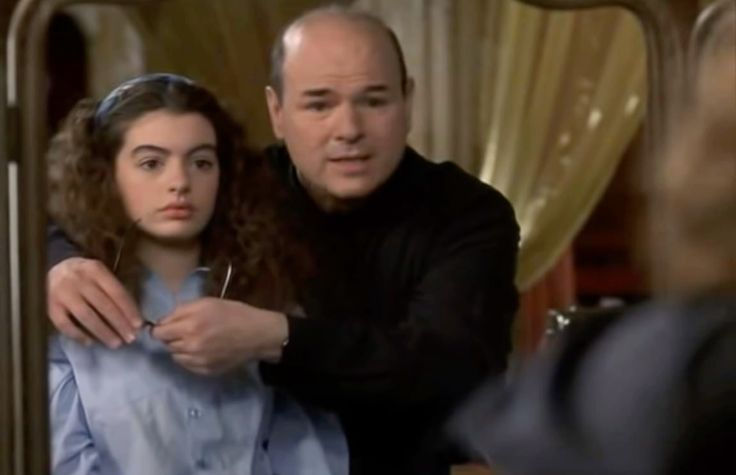
This perpetual idea of a complete metamorphosis is reinforced by the fact that every conversation between Mia and Paolo happens in front of a mirror. We can only see the back of Mia’s head while Paolo takes care of her hair. A possible interpretation that we could surmise is that she turns her back to us (the spectators who know her personality very well since we have watched the whole movie until here) to embrace her new remodelled self and lean into what Paolo makes of her. The mirror almost works as a second screen in which Paolo and Mia have a private conversation, leaving us – the audience, who remembers the former Mia – outside of it : this impression of a need for newness and novelty is ubiquitous.

There are several close-up shots on the tools used to relook Mia, making them look menacing and inescapable – Paolo uses his blow-dryers as weapons, like guns –, and sometimes even extreme close-ups – the focus on Mia’s eyes and frowning eyebrows makes the tweezers seem menacing to a suffering protagonist.
The choice to include foreign languages (Italian and some sort of caricatured Russian or German) suggests that Mia does not understand what is happening at all. This Pygmalionesque transformation transforms a weird teenager into a well dressed near-adult that finally has good appearances.

Still, the whole scene is made very comical and quirky, because in the film, Mia seems to relatively enjoy it. Several close-up shots, medium shots, or medium close-up shots display her listening to music, relaxing, and having a great time. It is not the case in the novel.

At the end of the makeover, Paolo proudly reveals his “artwork” to Queen Clarisse with the sentence : “Your Majesty, Paolo is exhausted. Because Majesty, only Paolo can take THIS and THIS and give you… a princess!”. By aggressively pointing to Mia’s “before” photos and referring to them as “this” as if she were not even human but merely an object or a repulsive creature, Paolo reinforces the stereotype that she had no worth before becoming “beautiful”. It is not absurd to wonder how seeing this might affect teenagers who look like the older version of Mia.
We can also pick up the fact that in the “before” pictures, Mia does not smile. She squints and has her mouth open, as if she were not ready for a picture or as if she simply did not know how to act when her photo was taken. She is the epitome of a “messy teen”. However, after her makeover, she smiles with her teeth, calmly and confidently, as if all of her usual weirdness had disappeared and she had finally seen the light, to enter into what society expects of her. How could the young girls watching aspire to be confident if even popular Disney movies deem them as unattractive and teach them that the one thing they can do to improve their life is change their whole appearance?

At the end of the scene, Mia finally manages to sit properly, like her Grandmother has taught her during princess lessons (tucking one foot behind the other). She does so almost automatically, signifying the crucial change that represents the makeover; it is not only a change of appearance – her whole character is evolving and leaning into her new role as a princess.
The viewer gets the impression that Mia is satisfied with her appearance because of her wide smile when she looks in the mirror. In the next scene, she even seems proud to show her new hair to Lilly, and becomes sad when her friend does not approve.
A knowing reader might be surprised, because what the book shows is all the contrary : “But I am not happy. I am not a bit happy. Grandmère’s happy. [...] Because I don’t look a thing like Mia Thermopolis”. While in the book Mia regularly chews on her fake nails, symbolically displaying a form of reluctance and resistance to conformism, in the movie she rapidly leans into her new-found beauty, which results in a dramatic scene during which she slowly takes off her hat, exhibiting her brand new shiny and smooth hair to her stunned classmates.
It is crucial to bear in mind that the book does not describe this scene : since Mia could not write as the events were happening, she can only narrate it after it has already happened. We can only have access to the aftermath, while the movie insists on showing every step, insinuating that it is a pivotal scene. It is nothing more than a usual makeover scene, and it does not show a lot if Mia on her chair with cucumbers on her eyelids.
However, it is very telling for the rest of the story. As a matter of fact, while in the book Mia does not start to feel like a princess until after a while, the almost objectifying gaze of the movie clearly signifies to us that the makeover scene is a huge turning point; since Mia is now “beautiful”, it is time for the viewer to take her seriously as a princess. The rest of the movie can now take place with an audience that has changed its point of view.

Final verdict : did The Princess Diaries (2001) reign supreme?
While Marshall’s movie deviates greatly from the book, it is still a good adaptation, since as Truffaut says, “les traductions fidèles ne sont pas celles du mot à mot”. Marshall managed to convey themes and elements from the novel, adding his own spin to it, but always tackling the adolescent experience with finesse and humour.
We can thus answer the question that Bluestone asks in the introduction of Novels into film : “is the mating of a novel and a film a natural marriage or a shotgun wedding?” In this case, the option of a natural marriage is prominent, reconciling both the readers and spectators.
However, Deborah Cartmell (“Adapting Children’s Literature”) claimed that “the marriages [between a literary text and its film adaptation] are never equal, with one partner invariably, unwittingly, or deliberately, preying upon the other”.
In the eyes of the general public, the movies have certainly become more famous and appreciated, and have taken precedence over the texts – two more successful Princess Diaries movies have been made since 2001, following the order of the novel series. Yet, in my opinion, the novels have more depth and really dive into a more profound characterization of the protagonists, as they contain parts of the story that have been restrained by the filmmaker. Art is all about creating a work with a new point of view, and adaptation is not exempt from this idea.
Finally, it is key to remember that Disney has a claim on the “princess narrative”, as proven by the countless animation movies, and that Mia certainly had to fit this narrative to be included in Disney’s catalogue – we cannot be too angry at Garry Marshall for softening her character and make her acceptable for the big screen.
Nevertheless, since 2001, society has evolved, as have Disney's values – in the near future, we can certainly hope for a modern Disney princess, one even more relatable for young girls than the one Anne Hathaway tried to achieve with Mia Thermopolis.
Thank you so much for reading the whole thing ! I hope it was somewhat inspiring and provided some food for thought. See you in my next post :)
Malou
Works cited in this post :
Albrecht-Crane, Christa and Cutchins Dennis. Adaptation Studies : New Approaches. Fairleigh Dickinson Univ Press, 2010.
Andersen, Kirsten. This is what dreams are made of : the effects of adaptation of popular tween/teen girl novels, films, and screenplay novelizations on constructions of varying femininities : The princess diaries and The Lizzie McGuire movie, University of British Columbia, 2005.
Andrew, Dudley. Concepts in film theory. Oxford University Press, 1984.
Bluestone, George. Novels into film, University of California Press, 1966.
Cartmell, Deborah. “Adapting Children's Literature.” The Cambridge Companion to Literature on Screen, 2007.
Hutcheon, Linda. A Theory of Adaptation. Routledge, 2006.
Jauss, Hans Robert. Pour Une Esthétique de La Réception. Gallimard, 1978.
Lawrence, Dana and Montz, Amy. Adaptation in Young Adult Novels : Critically Engaging Past and Present. Bloomsbury Academic, 2020.
Machado, Alleid Ribeiro. Female ways of representation in the teen chick lits: a study around The Princess Diaries, 2007.
McCallum, Robyn. Screen Adaptations and the Politics of Childhood: Transforming Children's Literature into Film, 2018.
Ramon Ana-Christina. The diversity report : Flipping the script. 2015.
Stam, Robert. "Beyond Fidelity: The Dialogics of Adaptation" in Film Adaption, 2000.


